 |
          |
Follow the story on
 AN INVESTIGATIVE NEWS SERIES ON THE STANDARDS AND PRACTICES OF THE BETTER BUSINESS BUREAU START WITH TRUTH |
|
V 1.2 April 2009 |
||
 |
||
| CURRENT
STORY: BBB Grades Banking and Credit Card Institutions A+. Do You? Apr 23 Executives from the leading banking and credit card companies have been summoned to the White House to discuss deceptive trade practices and lack of transparency issues. Financial institutions were one of the most complained about industries in 2008 according to the BBB, yet the financial firms invited to the White House--all Better Business Bureau members--received grades of either A+ or Satisfactory. HERE'S STORIES bbbROUNDUP HAS BEEN WORKING ON IN ITS SECOND 30 DAYS Apr 22 bbbRoundup Outs the LA BBB Algorithm. This is the actual three page document that contains the LA BBB algorithm, which serves as the foundation for the current national BBB Letter Grade system. More Goofy Grades show the algorithm needs work. Apr 9--Apr 21 The Anatomy of a Complaint: bbbRoundup disects the LA BBB Complaint Process and discovers why it offers little closure to both consumer and business. Last of three-article look into how complaints are received at the LA BBB, how they are input into their database, how businesses are notified (or not) about these complaints, and where the consumer fits in the scheme of things. Assumptions, judgment calls, manpower shortages, and lack of procedures haunt the complaint process, suggesting that many BBB complaint histories are without value, indeed may often be misleading, to the consumer. IN ITS FIRST 30 DAYS bbbRoundup HAS BROKEN THE FOLLOWING NEWS STORIES April 04.2009
Apr 4 Revealed bbbRoundup.com server
logs showing BBB Regional and National Office activity immediately
after March 19th memo from National BBB office was sent to regional BBB
offices.Apr 3 Published leaked internal BBB memo from Steve Cox, spokesperson for the CBBB (National Better Business Bureau Headquarters) to the regional BBB offices. He outlined the approach all BBB personnel were to take: be aware of bbbroundup; don't talk to the media or issue any statements about bbbroundup; if questioned about bbbroundup refer everything to Steve Cox at the national office; and don't forward any electronic messages because they could be forwarded outside of the BBB like this one was. Apr 3 (It was a busy day!) Provided an alternate theory to explain why the National BBB implemented the controversial Los Angeles Better Business Bureau Letter Grading system for businesses. IRS tax records suggest (surprise) that money could be behind the switch. Mar 30 Revealed the true TOB (type of business) the Los Angeles Better Business Bureau engages in. In a case of if it walks like a duck, talks like a duck....90% of the LA BBB annual revenues come from telemarketing sales of memberships. Telemarketers account for 40% of LA BBB employees. It's reasonable to surmise the Los Angeles Better Business Bureau core business is telemarketing. Mar 20 National BBB and Los Angeles BBB makes changes to Disneyland and Los Angeles Times grades, moving them both from "F" grades to "A" grades with no significant changes in complaints nor any explanation or notification of these changes. Mar 19 Steve Cox sends internal memo to regional BBB offices dictating how they were to deal with bbbroundup. This memo later was leaked and published by bbbroundup on April 3. Mar 19 Filed first report, a look at the inconsistencies in grades given to businesses by the BBB. Why Disneyland should have a "F" grade and Disney World a "B" grade or the Los Angeles Times an "F" grade while the San Francisco Chronicle received an "A+" were questions raised through actual screenshots of a number of BBB Letter Grades for various, well known businesses. Mar 12 V1.0 of bbbroundup published. One of the first articles outlined why this retired reporter got interested in the story. Mar 4 domain and hosting setup for bbbroundup.com KEEP READING. THE NEXT 30 DAYS WILL BE EVEN MORE EVENTFUL Jimmie
Rivers
|
||
|
||
| 5
THINGS YOU MAY
NOT KNOW ABOUT THE BBB 1) The Better Business Bureau is NOT a government agency. Instead the BBB is a private 501(c)(6) organization with $143 Million in annual revenues derived from membership dues it receives from the very businesses it reports on. 2) Attorney General questions new BBB Grading System. The Connecticut Attorney General is looking into the practices of the Better Business Bureau after they gave their annual Torch Award for Best Business to Custom Basement, a firm under investigation for violation of consumer protection laws. 3) U.S. Representative says BBB negatively classify businesses they don't like. Addressing Congress, US Representative Corrine Brown said some BBB's libel and slander small businesses they don't like while rating other companies with terrible records as being satisfactory. 4) Membership in the BBB guarantees a better grade. By their own admission, membership in the Better Business Bureau improves a business' grade. Calling this a membership service is a misnomer, it more closely resembles an advertising service where "members" pay to play. 5) Even the Better Business Bureau is NOT a member of the BBB. Not only does this exhibit a lack of confidence in their own product, it makes it impossible for anyone to complain about the Better Business Bureau to the organization. |
QUOTES FOR MILLENNIUM "Variables plugged into the (BBB grading) algorithm include government actions against a business."2 Judy Mills, President and CEO of the Southwest Missouri BBB "Your Connecticut Better Business Bureau is not a government agency and does not report on government actions."2 Howard Schwartz, Connecticut Business Bureau  "A right to redress the actions of the Better Business Bureau when libelous, slanderous, arbitrary, or capricious action is apparent is a fundamental right we must insure." Corrine
Brown U.S. Congress
|
|
|
| Editor's
note: Neither I or this website have a problem with the Better
Business Bureau. Indeed, there is a need for a consumer advocacy
group that the public can turn to, and in most cases, the Better
Business Bureau fulfills this role adequately. What we do have a
problem with is the BBB's "A-F" grading system. It is
demonstratively biased, based on hearsay, weighted in favor of dues
paying members and offers no recourse when the BBB makes an
error. It is obvious the Better Business Bureau does not now, nor
ever will have, the resources to fully investigate the four million
businesses in their database, much less grade them with any sense of
accuracy. It's an impossible job, and to think otherwise is a
mistake that the BBB should acknowledge so they can get back to their
reason for existence--protecting the consumer. There's an old
saying, "who will watch the watchers" and it applies here as the BBB
has set themselves up to be above the law. We are simply here to
help the Better Business Bureau do a better job so that they may
properly serve the consumer, the business community and themselves. |
|
|
|
|
You Be The
Judge: Does the Better Business Bureau exhibit favoritism when
grading members vs. non-members?
In
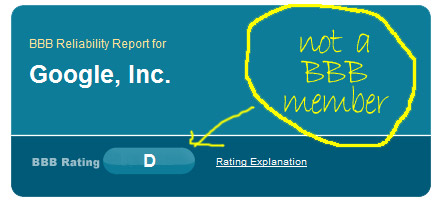
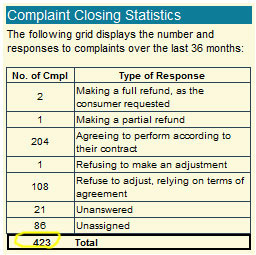
February, 2009, we compared the San Jose Better Business Bureau's
Grades for two similar businesses: Google and Yahoo!
Despite having 1/3 the complaints of Yahoo!, Google was given a D grade
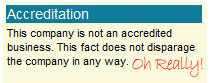
while Yahoo! received an A. The only noticeable difference is
that Yahoo! is a BBB member and Google is not. The BBB admits to
giving member businesses a bump in grade and implies it is a half-point
bump (A to A+). These screen shots suggests members are favored
more than that. Editors note:
On April 15, Google's Grade was raised to a "B" and on April 17
Google's grade again improved to an "A-" in spite of the fact that
their complaint total rose to 449.
|
|
   |
Original image unavailable: BBB grade for Yahoo!. Original image unavailable: Yahoo! complaints from Better Business Bureau.Original image unavailable.
|
|
Conclusion: It Seems
To
Pay To Be A Member Of The Better Business Bureau.
Here's
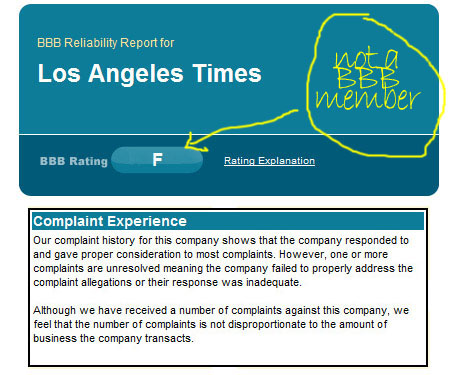
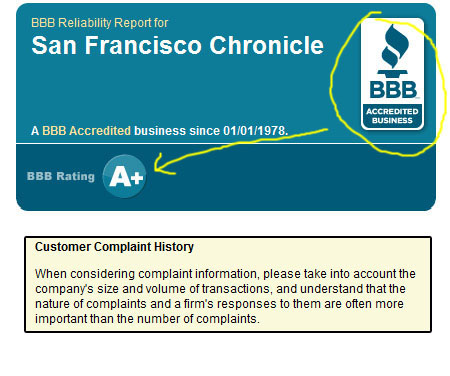
another example of two similar businesses, the Los Angeles Times and
the San Francisco Chronicle--both major market, reputable
newspapers from February 2009. There are two differences between
them: 1) They
are graded by two different regional BBB offices (Los Angeles and San
Francisco) and 2) the San Francisco Chronicle is a BBB member, the Los
Angeles Times is not. This suggests either members are favored
over
non-members or different regions grade differently. Editors
note:
On March 20th, the grade for the Los Angeles Times was improved to an A
with no explanation (or announcement) for the change.
|
|
 |
 |
|
Of Course, Grades From Some BBB Offices
Seem Goofier Than Others.
To
great fanfare, the National Better Business Bureau rolled out their new
"A" through "F" grading system, and pointed with pride to their
proprietary
algorithm based on 16 individual criteria for determining a business'
grade while ensuring all businesses--members and non-members were
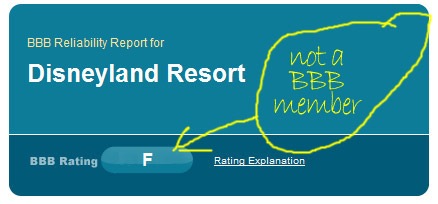
graded alike. It's difficult to reconcile this example of a
non-member business (Disney Theme Parks), operating in two different
Better Business Bureau regions (Los Angeles and Orlando), getting such
widely disparate grades as of February 2009. Orlando's Walt
Disney World received
three times the complaints as Los Angeles' Disneyland, yet had a much
better grade (B vs. F). This suggests there is a difference
in how different Better Business Bureau offices apply what is supposed
to be the same, standard algorithm, at least when they grade non-member
businesses. Editors
note:
On March 20th, the grade for the Disneyland Resort was improved to an A
with no explanation (or announcement) for the change.
|
|
 Los Angeles BBB Grade 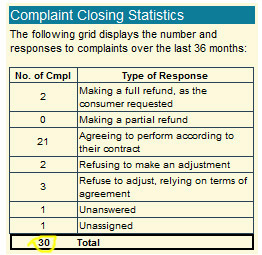 |
Original image unavailable: Walt Disney World BBB Grade. Orlando, Florida BBB Grade Original image unavailable.
|
|
|
|
But Don't Take Our
Word For It. Here's Some Additional Food For Thought.
We're
not the only one who has noticed these troubling instances of seeming
impropriety in the Better Business Bureau's treatment of non-member
businesses. There are news stories, from reputable news
organizations, in at least a dozen states that reference allegations of
"Pay to Play" grading taking place in regional BBB offices. Here
are two of them...more to come.
|
|
 excerpts
from January 21, 2009 column in the Los Angeles Times If you check out Wolfgang Puck's Spago restaurant on the Better Business Bureau's website, you'll discover that, under the organization's new rating system, the world-famous Beverly Hills eatery merits a grade of B-minus. Why? That's hard to say. The online report says the bureau has received no complaints about Spago from customers and is unaware of any government actions against the restaurant. Now check out the considerably less prominent Cafe Santorini in Pasadena. It too has prompted no complaints to the bureau and has no government actions outstanding. It gets a grade of A-plus. One big difference: Cafe Santorini pays the bureau about $350 a year to be listed as an accredited business. Spago makes no such payments and is thus an unaccredited business. Why do so many unaccredited businesses get significantly lower grades? "I can't explain that," Steve Cox, a spokesman for the Better Business Bureau replied. "Clearly we need to do a better job in articulating what the differences are." For Full Los Angeles Times Story, Click Here. |
 FROM THE CONGRESSIONAL RECORD I have learned that we have within our country a private organization that with the appearance of being quasi-governmental and without any legal or regulatory oversight and control can libel and slander and tortuously interfere with a small business. They can do so with virtual immunity. This organization is the National Better Business Bureau and their franchise local Better Business Bureaus. At times, some of these bureaus classify small business owners as unsatisfactory, libel and slander them with opinion and innuendo, and provide them no due process to correct the problem. If sued in court, they argue qualified immunity under the guise of the public good. No one disputes the right of a Better Business Bureau to print facts. It is when they print falsehoods, opinion, or negative innuendo that a mechanism for redress or correction must be assured. When closely examined, however, one finds that there are Better Business Bureaus that arbitrarily and capriciously exclude and negatively classify those they don't like. They also frequently rate companies with terrible records as being satisfactory. For Complete Statement of Representative Brown, Click Here. |
|
|
| ©
2009 bbbroundup.com all rights reserved. |
|